
Understanding FDA Product Classification for Medical Devices
Finden Sie sich auf den Webseiten der FDA zurecht

Product Classification
The U.S. Food and Drug Administration is the central federal authority responsible for the clearance and approval of medical devices in the United States. The respective regulatory pathways (primarily 510(k), De Novo, and PMA) are sufficiently well described in FDA training materials and will only be mentioned briefly in this article.
Instead, we focus here on the classification levels the FDA applies to medical devices, and what information these levels provide about your own products.
First, a comparison with European regulations: The MDR formally defines four risk classes (I, IIa, IIb, III) and sets out a catalog of classification rules in Annex VIII. This is supplemented by MDCG 2021-24, which provides examples and guidance on the application of these classification rules.
In the United States, a risk-based classification system also exists (Class I, II, III). However, a universally applicable catalog of rules is nowhere to be found.
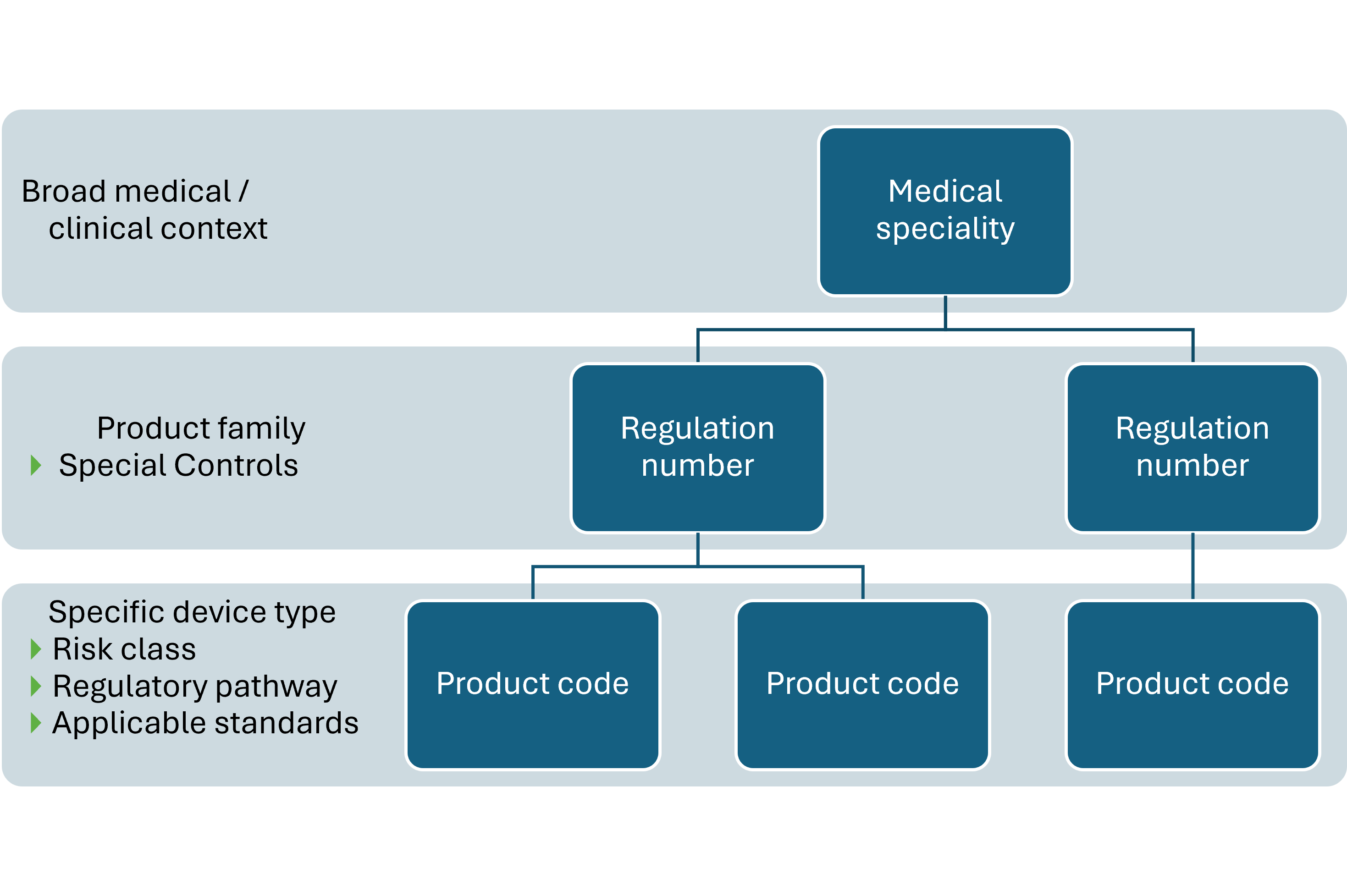
The FDA has simply chosen a different approach to grouping medical devices. Classification takes place on three levels:
- Medical Specialty (broadest level)
- Regulation Number (intermediate level)
- Product Code (most specific level)
Only at the level of the Product Code does it become clear which risk class and which regulatory pathway (e.g., 510(k)) apply to a given product. For example, Class I and Class II products may require a 510(k) or may be 510(k)-exempt.
A systematic search for the applicable Product Code therefore marks the starting point of any submission project in the United States. The following sections examine and illustrate each of these levels in further detail. We will then present example approaches for navigating these levels, enabling you to identify potential Product Codes – and thus the applicable risk class and regulatory pathway – for your own products.
Medical Specialty
Medical Specialties, also referred to as Device Classification Panels, represent a specific clinical-medical field. Currently, 19 Medical Specialties are defined. Each is codified in a dedicated part of Title 21 of the Code of Federal Regulations (CFR) – the U.S. federal law governing medical devices – for example: "Cardiovascular" (21 CFR 870), "Gastroenterology and Urology" (21 CFR 876), or "Ear, Nose, and Throat" (21 CFR 874). At this level, no concrete regulatory information specific to an individual product is yet discernible. Rather, this level serves for orientation: in which clinical-medical specialty does my product sit?
Depending on the product, the applicable specialty may not be immediately clear – it is therefore advisable to approach the research from multiple angles.
The Medical Specialties can be found on the FDA website. Clicking on the linked section of 21 CFR will automatically navigate to the next level: the Regulation Numbers.
Regulation Number
Each Medical Specialty contains, in addition to introductory and administrative provisions, a series of Regulation Numbers. These build upon the relevant part of 21 CFR for the applicable Medical Specialty – for example, 21 CFR 870 for "Cardiovascular" – and append a four-digit number. For instance, 21 CFR 870.3925 is the Regulation Number for "Replacement Heart Valve." A Regulation Number describes a type of product family within a given clinical-medical context (Medical Specialty).
At the Regulation Number level, a description of the product family, a risk classification, and, where applicable, so-called Special Controls can be found. Special Controls are specific requirements that products within a given Regulation Number (product family) must fulfill. These may be described in dedicated FDA guidance documents (e.g., for dental implants) or specified directly within the Regulation Number itself. Special Controls address, among other things, specific aspects to be evaluated in bench tests, animal studies, or clinical trials, and may also set product-specific requirements, such as those relating to labeling.
Product Code
One or more Product Codes are assigned to each Regulation Number. If the Regulation Number represents a product family, then Product Codes are the individual members of that family.
The size of this "family" can vary considerably. For example, Regulation Number 876.1500, "Endoscope and Accessories," encompasses 123 Product Codes – meaning the FDA-defined product family of "Endoscope and Accessories" has 123 members. Other Regulation Numbers, by contrast, contain only a single Product Code.
It is only at the Product Code level that the applicable risk class and intended regulatory pathway become clear. Product-specific standards to be taken into consideration may also be indicated at this level.
Figure 1 summarizes the FDA's approach to medical device grouping. Only at the Product Code level does the applicable regulatory pathway for a given product become apparent.
Illustrative Example
The following example illustrates the classification process using a sample product: a sponge intended to be placed inside the body during open surgical procedures for the purpose of hemostasis, designed for short-term use.
The context of use is relatively non-specific and falls within the general area of surgical procedures. The Medical Specialty "General and Plastic Surgery Devices" (21 CFR 878) is therefore a natural starting point.
This Medical Specialty encompasses 102 Regulation Numbers. Searching for "Sponge" within this specialty yields two results:
- 21 CFR 878.4014: Nonresorbable gauze/sponge for external use
► Does not apply, as external use is indicated - 21 CFR 878.4452: Nonabsorbable expandable hemostatic sponge for temporary internal use
► This appears to be on the right track
Under 878.4452, a description of this Regulation Number can be found. In addition to a more detailed product description, a comprehensive set of Special Controls is listed. For example, non-clinical performance testing (typically meaning bench tests) must address aspects such as the extent of expansion, absorption properties, and mechanical characteristics. Additionally, in-vivo performance data must be generated through animal studies, or clinical data on aspects such as deployment and control of bleeding must be collected.
Searching the FDA product classification database using Regulation Number 878.4452 yields one result:
Product Code: PGZ
Device: Non-Absorbable, Expandable, Hemostatic Sponge for Temporary Internal Use
Device Class: 2
Submission Type: 510(k)
Without going into further detail at this point: the 510(k) submission is based on demonstrating the substantial equivalence of one's own product to a product already on the US market. It is therefore clear that a so-called "predicate device" must be identified for such products.
The substantial equivalence argument allows for some flexibility; however, a predicate device from the same Product Code should generally be used.
Once the Product Code is known, candidate products can be identified relatively quickly. The 510(k) database can, for example, be searched using the Product Code as a search term.
In the case of the non-absorbable hemostatic sponge (Product Code "PGZ"), five specific products are available for consideration. These should be carefully evaluated in order to make an appropriate predicate device selection.
Tips
The approach outlined above closely follows the FDA's classification hierarchy. In some cases, the decision may already be ambiguous at the Medical Specialty level. It is therefore advisable to approach the search for the correct Product Code from multiple angles. A similar product from another manufacturer that has already been cleared for the US market can provide a useful reference point.
To find the Product Codes for already-marketed products, products and/or manufacturers can be searched in the "Establishment Registration & Device Listing" database.
Outlook and Summary
Unlike European regulations, the FDA does not work with a defined catalog of rules for classifying medical devices. Instead, a comprehensive grouping of medical devices takes place across three levels:
- Medical Specialty: Broad clinical-medical context
- Regulation Number: Representation of a product group within a medical context
- Product Code: Specific product type within a product group
At the Regulation Number level, Special Controls may be defined – these represent concrete requirements that products within the Regulation Number must address.
At the Product Code level, the applicable submission pathway is defined, among other things.
A thorough understanding of the FDA's medical device grouping system and a systematic search for potentially applicable Product Codes are essential to approaching an FDA submission correctly.
The FDA databases are interlinked – clicking "new search" displays a dropdown menu on the right-hand side for navigating to other FDA databases, allowing information from one database to be quickly entered into the search interface of another.
In general, it is advisable to practice working with the FDA databases. In addition to understanding the grouping of medical devices and the Regulation Number and Product Code research described here, the FDA is actively working toward greater standardization in predicate device selection. An FDA guidance document is currently under development describing best practices for predicate device selection. While the draft version available to date has not yet been finalized, it is evident that the FDA aims to better understand, in 510(k) submissions, on what basis a predicate device was selected at the outset of the 510(k) process. Documenting and justifying the predicate device search and selection is therefore strongly recommended.
We encourage you to try it out and research the Regulation Numbers and Product Codes that may apply to your products – this is the first step toward a successful clearance of your medical devices on the US market. We are of course happy to support you with our expertise at this – and every subsequent – step.