
Risk Management and Warnings: How Risks Can Be Reduced
Wie sich Risiken senken lassen

That risk analysis is a living document should be well established knowledge, at the latest since the introduction of EU Medical Device Regulation 2017/745 (MDR). The MDR defines risk as: "the combination of the probability of occurrence of harm and the severity of that harm." Risk analysis evaluates risks that have either been anticipated prior to market launch or have become known during use in everyday clinical practice. Based on the severity of harm and the probability of its occurrence, the manufacturer assesses whether a risk appears acceptable in light of the associated benefit. Unacceptable risks must necessarily be reduced in terms of either severity or probability; however, implementing a design change is a highly resource-intensive undertaking. It therefore seems straightforward to use the more easily adaptable instructions for use (IFU) to inform users about the risk and thereby reduce the probability of its occurrence. This article explains when this measure is sufficient, and what relationship exists between risk analysis and clinical evaluation.
Why Reduce Risks?
The MDR (Annex I, Chapter 1, Point 1) is unambiguous on this point: "They [the devices] shall be safe and effective and shall not compromise the clinical condition or the safety of patients, nor [...] the health of users or, where applicable, third parties." It further states that "[...] risks shall be reduced as far as possible without adversely affecting the benefit-risk ratio." What options does a manufacturer have for reducing risks, and what requirements does the MDR impose?
Manufacturers have an inherent interest in minimizing risks, as safe products will, over the long term, outperform competitors. The MDR provides tools to support risk reduction.
Risk-Reducing Measures
With the entry into force of the MDR, an important rule regarding risk-reducing measures was fundamentally changed. As part of risk reduction under the previous framework, it was not possible to reduce risks through a warning alone – for example, in the instructions for use.
ISO 14971:2012 and Directive 93/42/EEC
ISO 14971:2012 (Risk Management for Medical Devices) states in Annex ZA, Section 7(b): "that users are to be informed of residual risks. This indicates that, under Directive 93/42/EEC, Annex I, and contrary to the view of the standard, information provided to users does not further reduce the (residual) risk."
Risks therefore had to be minimized through design or protective measures. Residual risks that could not be further reduced had to be – and must still be – outweighed by the benefits, and were addressed in warning notices.
What Changes Under the MDR
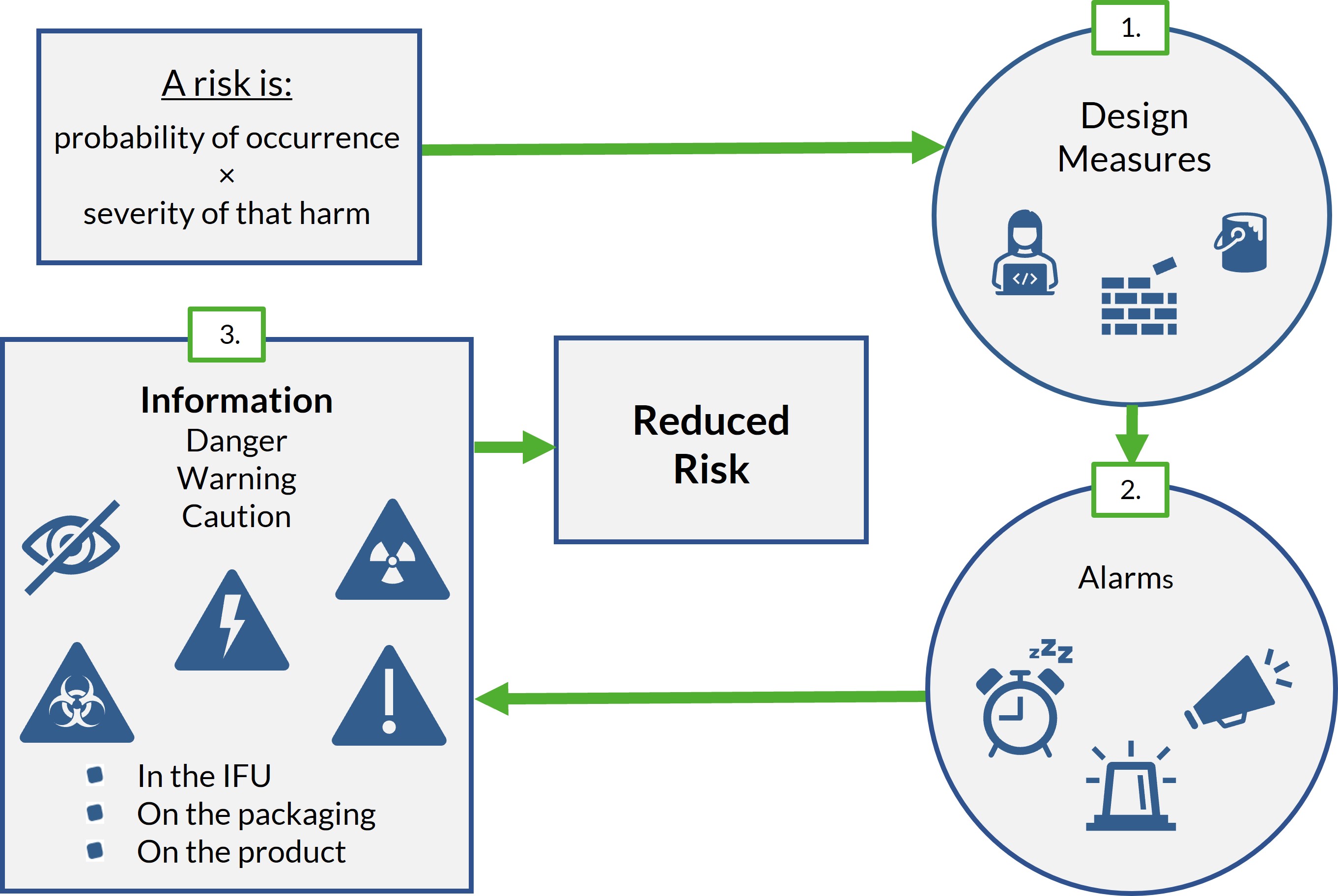
The good news: under the MDR, risks may be mitigated through warnings and information in the instructions for use. However, the hierarchy of risk-reducing measures must still be observed, and this step must be justified where necessary. MDR Annex I, Point 4 states:
"In selecting the most appropriate solutions, manufacturers shall, in the following order of priority:
- eliminate or reduce risks as far as possible through safe design and manufacture,
- where appropriate, take adequate protection measures, including alarms if necessary, in relation to risks that cannot be eliminated, and
- provide safety information (warnings, precautions, contra-indications) and, where appropriate, training to users."
The Hierarchy of Measures
This means that risks must preferably be reduced through design measures – for example, by equipping a pacemaker with a particularly long-lasting battery to prevent loss of function. If the risk remains unacceptable thereafter, protective measures must be implemented – for example, by programming the pacemaker to issue an alarm before the battery is depleted. Only when the risk cannot be reduced further may a manufacturer use a safety notice in the instructions for use as a risk-reducing measure – for instance, by indicating that the battery has a limited lifespan.
Whether a manufacturer has exhausted all design and protective measures, and whether these are sufficient, must be assessed on a case-by-case basis. Manufacturers should be prepared for queries from the Notified Body and be able to justify their approach.
More Is Not Always Better
It is important not to over-rely on this type of risk reduction through excessive warnings and notices.
ISO/TR 24971:2020, Section 8.2(d), is clear on this point: "An analysis might be needed to determine if there is an over-reliance on warnings."
Warnings should therefore be used responsibly. Whether the notices achieve the desired effect can be verified, for example, through usability testing.
Effective Use of Warnings
When warnings are used, their wording and format should be chosen with care. To date, no harmonized standard specifically addressing warnings exists. The MDR itself covers this topic only briefly, stating in Annex I, Section 23: "The medium, format, content, legibility, and location of the label and instructions for use shall be appropriate to the particular device. [...] In particular, the instructions for use shall be written in terms readily understood by the intended user."
In the absence of specific MDR requirements, some Notified Bodies refer to applicable standards. Our experience shows that, for example, IEC 82079-1:2019, Part 1 – which governs the preparation of instructions for use – is considered relevant by some Notified Bodies, even though it does not specifically apply to medical devices.
According to this standard, information relating to personal injury should be labeled with the signal words Danger, Warning, and Caution. For property damage, the terms Notice or Attention should be used. There is no prescribed requirement regarding colors; however, they should be used consistently throughout
Danger, Warning, Caution, Notice
Adapted from IEC 82079-1:2019, Part 1:
Danger: A hazardous situation that, if not avoided, will result in death or serious injury.
Warning: A hazardous situation that, if not avoided, could result in death or serious injury.
Caution: A hazardous situation that, if not avoided, could result in minor or moderate injury.
Notice: A situation that, if not avoided, could result in damage to the device (or other property).
What Must Be Considered for the Clinical Evaluation?
The risk analysis and the warnings in the instructions for use are also incorporated into the clinical evaluation. The identified risks are carefully compared against clinical data from the literature:
- Do the identified risks – in terms of severity and probability of harm – align with the findings from the literature and post-market surveillance?
- Are there contraindications described in the literature that are not reflected in the instructions for use?
- Are the formulation and selection of contraindications consistent?
- Is the estimated probability of a risk occurring appropriately calibrated?
With reference to the IFU, it is also verified whether warnings specified in the risk analysis as risk-reducing measures have been implemented in the IFU.
In addition, it is assessed whether risks have been identified in a manner appropriate to the type of medical device.
Conclusion
- Manufacturers must first consider design and protective measures before using a warning as a risk-reducing measure.
- Where warnings are used to reduce risk, a usability test can demonstrate the effectiveness of the measure.
- Warnings can be formulated, for example, in accordance with IEC 82079-1:2019. While this standard is not yet harmonized and applies to all types of instructions for use (not specifically to medical devices), it provides manufacturers with valuable guidance. Since its predecessor standard was harmonized, it is quite possible that this version will be harmonized as well.
- In the conduct of the clinical evaluation, warnings used as risk-reducing measures are reviewed to verify their implementation.