
Clinical Evaluation Consultation Procedure: To-Dos for the Clinical Evaluation
To-dos für die klinische Bewertung

Many considerations have shaped the formulation of the Medical Device Regulation (EU) 2017/745 (MDR). Transparency and the protection of public health and patient safety are among the most prominently cited objectives. In order to keep pace with scientific and technical developments and to overcome diverging interpretations, the EU has established Expert Panels. These may be consulted by Notified Bodies in the context of the conformity assessment of certain medical devices. What is an Expert Panel? When must a product undergo the consultation procedure? What role does the clinical evaluation play? These questions are addressed in this article.
Which Products May Be Affected?
The CECP (Clinical Evaluation Consultation Procedure) is a procedure described in the MDR (Article 54 and Annex IX, Section 5.1). It is provided for as part of the conformity assessment for specific products, namely:
- Implantable Class III devices, and
- Active Class IIb devices intended to administer and/or remove a medicinal product to/from the body in accordance with Annex VIII, Section 6.4 (Rule 12), such as dialysis systems.
We will refer to these products as "CECP products" hereafter. The procedure may be initiated both during the initial MDR certification of legacy devices or new products, and during MDR recertification, provided that relevant changes have been made to the device.
When Is a CECP Not Required?
There are exceptions for CECP products in which the consultation procedure is not required. These are set out in Article 54(2) MDR:
- when a certificate issued in accordance with this Regulation [MDR] is renewed
- this refers to MDR recertifications;
- when the device has been designed by modifying a device already placed on the market by the same manufacturer for the same intended purpose, provided the manufacturer has demonstrated to the Notified Body's satisfaction that the modifications do not adversely affect the benefit-risk ratio of the device
- this refers to legacy devices being transitioned into the MDR with minimal changes;
- when the principles of clinical evaluation of the relevant device type or category have been defined in a specification pursuant to Article 9 and the Notified Body confirms that the clinical evaluation of the device by the manufacturer is in conformity with the relevant common specification for the clinical evaluation of that type of device
- this applies where relevant Common Specifications exist for the CECP product in question.
For the interpretation of Article 54 MDR, an additional MDCG document exists (MDCG 2019-3). This makes clear that legacy devices fall under the exception provided in Article 54(2b) MDR. The document also addresses the nature and extent of permissible changes, limiting this exception to changes that are necessary in order to comply with the requirements under the MDR – such as changes to the PMS system to account for the requirements relating to the Summary of Safety and Clinical Performance (SSCP), or changes to labeling in order to meet the applicable general safety and performance requirements.
What Triggers Can Initiate a CECP for Legacy Devices?
Although legacy devices are generally exempt under Article 54(2b), the following aspects may trigger a CECP even for these products:
- Changes to or extensions of the intended purpose and/or indications
- Extension of the patient population
- Addition of sizes or variants not covered by the previous MDD certification
- Significant changes to clinical procedures or surgical technique
- Changes to the device and/or its accessories that necessitate the evaluation of additional clinical data
How Does the CECP Work?
The consultation procedure is initiated relatively late in the conformity assessment process. The Notified Body informs the competent authorities as to whether the CECP is applicable (Article 54(3) MDR). The Notified Body must document its decision and make it available to the competent authorities via EUDAMED.
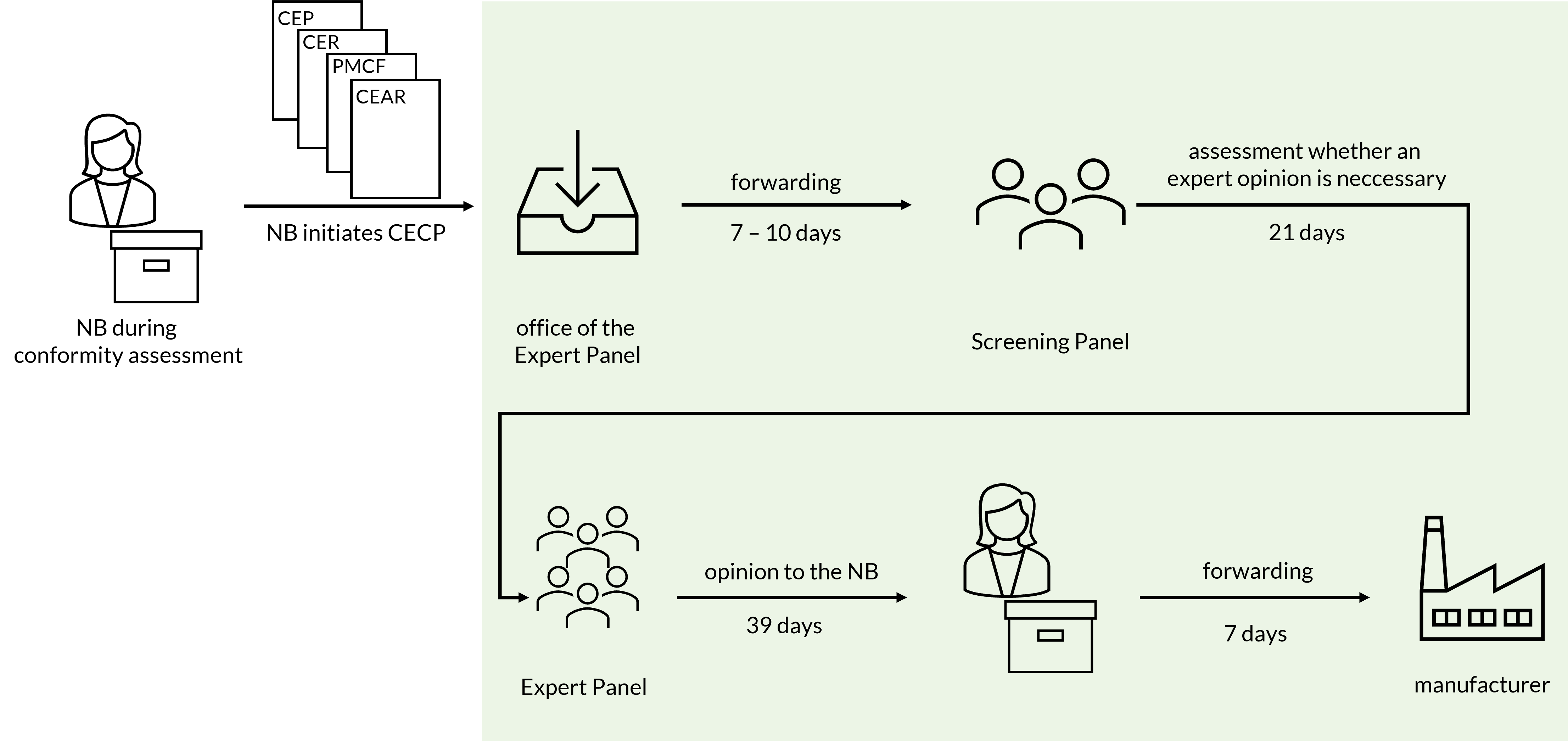
If the Notified Body decides to initiate the CECP, the following documents are submitted to the secretariat of the Expert Panels:
- Clinical Evaluation Plan (CEP)
- Clinical Evaluation Report (CER)
- PMCF Plan
- PMCF Report
- Clinical Evaluation Assessment Report (CEAR)
After 7 to 10 days, the submission is forwarded to the Screening Panel. The Screening Panel decides within 21 days whether a scientific opinion from an Expert Panel is warranted in the case at hand. The criteria considered by the Screening Panel are set out in Annex IX, Section 5.1(c) MDR:
- The novelty of the device in question or of the associated clinical procedure, and its potential significant clinical impact or impact on public health;
- A significant adverse change in the benefit-risk profile of a specific category or group of devices due to scientifically valid health concerns regarding their components or source material, or regarding the health impact of device failure;
- A significantly increased rate of serious incidents pursuant to Article 87 in relation to a specific category or group of devices.
If the Screening Panel concludes that a scientific opinion is to be provided, the information is forwarded to the relevant Expert Panel. The opinion is then submitted to the Notified Body within 39 days and must be passed on to the manufacturer within 7 days.
The time from initiation of the CECP to receipt of the information by the manufacturer is therefore 74 to 77 days in accordance with the MDR.
Expert Panels
There are 11 Expert Panels covering various medical specialties, each of which may have subgroups for specific sub-disciplines. The members of the Expert Panels are experts in their respective fields, appointed by the European Commission on the basis of their scientific, clinical, and technical expertise following a call for expressions of interest. The selection and appointment are made by the European Commission in consultation with the MDCG.
The composition of the Expert Panels and the published opinions are available on the European Commission's website.
What Impact Can the CECP Have?
The recommendations of the Expert Panels are not binding on Notified Bodies. The opinion is published on EUDAMED together with the decision of the Notified Body.
On the basis of the opinion, the Notified Body may restrict the intended purpose, limit the duration or scope of the certificate, or request adjustments to the technical documentation.
To-Dos for the Clinical Evaluation of Legacy Devices
Although an exemption for legacy devices exists under Article 54(2b) MDR, there are several aspects that can trigger a CECP in the context of the conformity assessment procedure – particularly changes to the device that affect safety. Since the Screening Panel decides whether a scientific opinion is to be obtained, it is advisable to already provide the Screening Panel with relevant information within the clinical evaluation.
The clinical evaluation should clearly identify any changes to the device or its definition in relation to the triggers listed above, justify the introduction of these changes, discuss the changes in a risk-based manner, and describe any risk-mitigating measures where applicable.
- These fundamental principles of change management strengthen the integration between the QMS and the clinical evaluation, and help the Notified Body (and, where applicable, the Expert Panel) to make appropriate decisions within the CECP.
In addition, the clinical evaluation should also include a discussion of any novelties, significant changes to the benefit-risk ratio, and, where applicable, the occurrence of serious incidents pursuant to MDR Annex IX, Section 5.1(c) (see above).
This discussion can facilitate the work of the Notified Body and the Screening Panel, and should also be considered for initial certifications.
Conclusion
The CECP is a procedure described in the MDR as part of the conformity assessment for certain Class III and Class IIb devices. An Expert Panel may be consulted by the Notified Body during the conformity assessment procedure. The Expert Panel may issue a scientific opinion, which the Notified Body takes into account when concluding the conformity assessment procedure. Legacy devices may also be subject to the CECP. The key criteria for initiating the CECP and for issuing a scientific opinion are, above all, novelty, significant changes to the benefit-risk ratio, and the accumulation of serious incidents. These aspects should be addressed in the clinical evaluation of potentially affected products – both legacy devices and new products – in order to facilitate the necessary decisions in the CECP process.