
Borderline Products
Abgrenzung von Medizinprodukten zu anderen Gruppen

Different regulatory requirements apply in the European market depending on the product category. For example, food safety is governed by Articles 168 and 169 of the Treaty on the Functioning of the EU, food supplements by Directive 2002/46/EC, and medicinal products by Directive 2001/83/EC. Difficulties arise with product categories that cannot be clearly assigned to a single regulatory framework, or that fulfill multiple regulatory definitions. Such products are referred to as borderline products. How, then, should a product such as a massage chair be treated – one that can be used both for the treatment of severe muscle tension and for relaxing massage after a workout? In this article, we describe the definitions of medicinal products, medical devices, combination products, and wellness products.
Definition of a Medical Device Under Article 2(1) MDR
Medical devices are products that, according to the manufacturer, are intended for use in human beings and fulfill at least one of the following medical purposes:
- Diagnosis, prevention, monitoring, prediction, prognosis, treatment, or alleviation of disease;
- Diagnosis, monitoring, treatment, alleviation of, or compensation for injury or disability;
- Investigation, replacement, or modification of anatomy or of a physiological or pathological process or state;
- Providing information by means of in vitro examination of specimens derived from the human body, including organ, blood, and tissue donations;
- and whose principal intended action in or on the human body is not achieved by pharmacological, immunological, or metabolic means
Explicitly excluded from the MDR are, among other things, cosmetics, in vitro diagnostics, and medicinal products.
The definition of a medical device is therefore divided into two elements, both of which must be met for a product to be classified as a medical device: first, the intended purpose must be medical; and second, the desired effect must be based on the physical or mechanical properties of the product. There are few exceptions to this rule, including colored contact lenses and liposuction devices, which are listed in the MDR under Attachment XVI.
Distinction from Wellness and Cosmetic Products
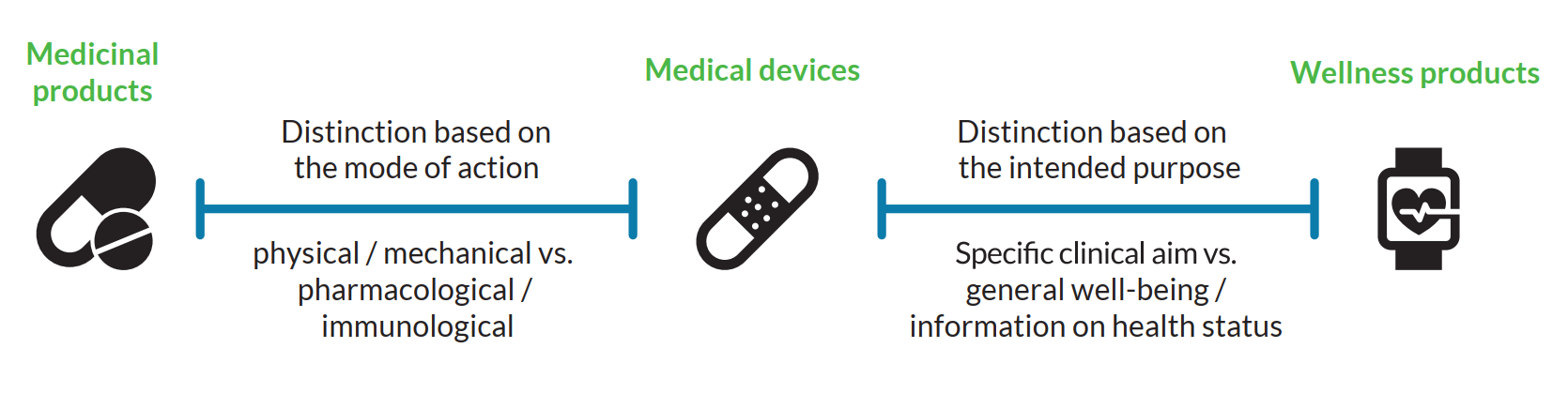
The distinction between wellness products and medical devices is made on the basis of the intended purpose. Technically identical products may thus be marketed either as a medical device or as a wellness product.
There are many examples of such borderline products:
- Personal scales for diagnostic purposes are classified as medical devices. A medical scale with bioimpedance analysis, for example, can be used to diagnose muscle wasting or obesity. The same scale could output raw data on muscle or body fat percentage without a diagnostic context, and thus constitute a wellness product for home use.
- Exercise equipment can be used both for sport and for medical purposes such as rehabilitation or physiotherapy. Here too, it is the formulation of the intended purpose in the instructions for use that determines whether a product qualifies as a medical device under the MDR.
- Massage products, as mentioned above, are classified as medical devices when claims are made regarding pain reduction or improved circulation. Products intended purely for relaxation fall within the wellness category.
Important
If clearance as a wellness product is sought, no clinical performance claims may be made and no reference to disease may be included. Furthermore, wellness products are intended for use by healthy individuals only, not by those who are unwell. The following marketing claims may be considered non-medical:
- Feel or look healthier
- Improve general health status
- Measure fitness performance or output (e.g., heart rate, step count, distance traveled)
- Improve (bodily) hygiene
- Support a healthy routine
Similar considerations apply to cosmetics as to wellness products, provided the product is not a medicinal product (see the following section): a product may qualify as either a cosmetic or a medical device, depending on the claimed effect (healing and alleviation vs. hygiene improvement, etc.). In fact, the ingredients of cosmetic products are currently subject to stricter regulation than those of medical devices – the list of prohibited cosmetic substances does not apply to medical devices. Medical devices may therefore incorporate potential contact allergens or denatured alcohol, even where these have long been prohibited in cosmetics.
Distinction from Medicinal Products
Medicinal products are among the most strictly regulated products on the market. According to the Association of Research-Based Pharmaceutical Companies in Germany, the average approval of a new medicinal product takes approximately 13 years and costs approximately USD 1.0–1.6 billion.
Medicinal products are defined in accordance with Directive 2001/83/EC as:
- Any substance or combination of substances presented as having properties for treating or preventing disease in human beings, or
- Any substance or combination of substances which may be used in or administered to human beings with a view to restoring, correcting, or modifying physiological functions by exerting a pharmacological, immunological, or metabolic action, or to making a medical diagnosis.
The first subpoint of the definition alone does not necessarily allow for a clear distinction between medical devices and medicinal products, as both may be used for the alleviation, treatment, or prevention of pathological conditions. Medical devices are therefore distinguished from medicinal products on the basis of the second subpoint of Directive 2001/83/EC. According to MDCG 2022-5, the decisive factor in each individual case is the mode of action. Products whose principal action is physical or mechanical in nature are classified as medical devices. Substances that act metabolically, immunologically, or pharmacologically are medicinal products. The mode of action is determined objectively on the basis of the state of the art in the scientific literature.
Should there be uncertainty as to which category a product belongs to, it will, in accordance with Article 2(2) of Directive 2001/83/EC, be classified as a medicinal product.
Combination Products – It's All in the Mix
Medical devices may incorporate medicinal substances to support their intended effect. This gives rise to combination products, consisting of a medical device and a medicinal product, where each individual component would qualify as one or the other. This product category must be considered separately from a regulatory perspective: depending on the primary mode of action, a combination product requires either clearance under the MDR with supplementary documentation pursuant to Directive 2001/83/EC, or authorization under Directive 2001/83/EC with supplementary documentation pursuant to the MDR. Furthermore, not every product containing a medicinal substance is automatically a combination product. A dedicated article on this topic will be published shortly.
Conclusion
- The definition of a medical device is divided into two elements: the intended purpose must be medical, and the desired effect must be based on the physical or mechanical properties of the product.
- Distinction from medicinal products is generally made on the basis of the principal mode of action.
- The mode of action is determined on the basis of the state of the art in the scientific literature.
- In cases of doubt, a borderline product will be classified as a medicinal product in accordance with Article 2(2) of Directive 2001/83/EC.
- Distinction from wellness products is based on the intended purpose defined by the manufacturer for the product.
- If market entry as a wellness product is sought, no clinical performance claims may be made and no reference to disease may be included.